

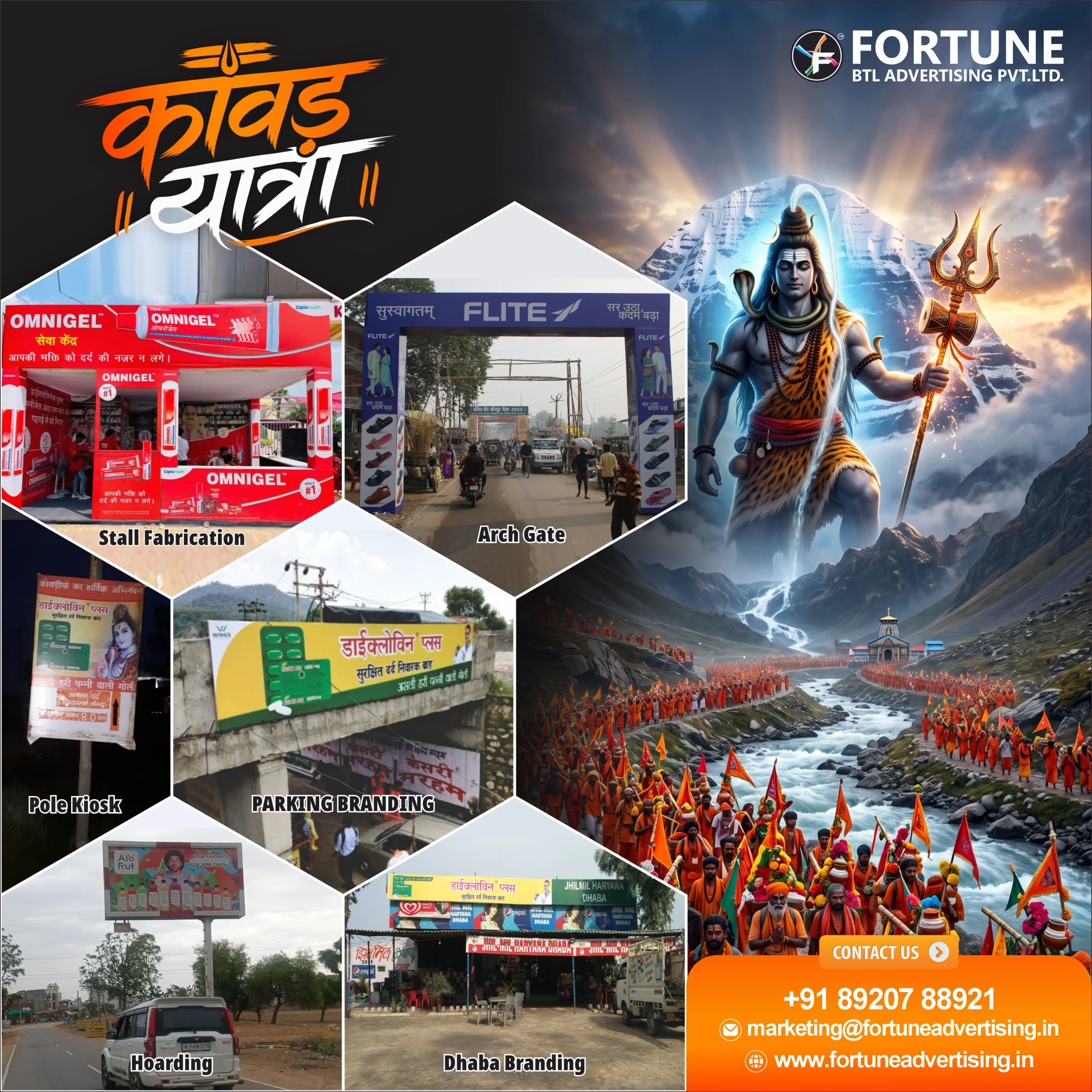
Every year, during the holy month of Shravan (also called Sawan), lakhs of devotees set out on the Kanwar Yatra — a pilgrimage in which they carry sacred water from the River Ganga to offer to Lord Shiva. For those who undertake it, the Yatra is far more than a tradition passed down through generations. It is a personal act of faith, discipline, and gratitude, and one of the most visible expressions of devotion in Hindu culture.
Over the decades, the Kanwar Yatra has grown from a quiet, local practice into one of the largest religious gatherings in India, drawing millions of participants and touching everything from local economies to state administration. This article looks at the history of the Kanwar Yatra, its mythological roots, why it continues to be celebrated, and how it plays out today — including why it has become significant for brands and advertisers as well.
What Is the Kanwar Yatra?
The Kanwar Yatra is a pilgrimage undertaken in honour of Lord Shiva. Devotees, known as Kanwariyas, travel to sacred points along the River Ganga to collect its water, which they carry back in a decorated bamboo structure called a Kanwar. This water is then offered at a nearby Shiva temple, poured over the Shivling as an act of worship.
Most Kanwariyas make the journey on foot — some walking just a few kilometres, others covering hundreds. Participants come from all walks of life and all age groups, often travelling in groups with family or with others from their village or town. Throughout the journey, the air fills with chants of “Bol Bam” and “Har Har Mahadev,” giving the entire route a distinctly spiritual atmosphere.
When Did the Kanwar Yatra Start?
There is no definitive date or year marking the start of the Kanwar Yatra — no historical record pins down its origin. Religious scholars generally agree that the practice is ancient, rooted deeply in Hindu belief systems centred on devotion to Lord Shiva.
What began as a personal or small-community act of offering water to Shiva gradually evolved, over generations, into the large, organised pilgrimage recognised today. While its scale has changed enormously, its purpose has remained constant: an expression of faith, patience, and devotion to Lord Shiva.
In earlier times, only a small number of devotees undertook the journey, travelling quietly to nearby temples. As roads improved, transportation became more accessible, and awareness of the tradition spread, participation grew steadily. Today, the Yatra draws millions of Kanwariyas each year, making it one of the most significant religious pilgrimages in the country — yet its core meaning of simplicity, faith, and devotion remains unchanged.
The Mythological Origin of the Kanwar Yatra
The story behind the Kanwar Yatra traces back to Samudra Manthan, the Churning of the Ocean — one of the most important episodes in Hindu mythology, and the key to understanding why devotees offer Ganga water to Lord Shiva.
According to the legend, gods and demons came together to churn the cosmic ocean in search of Amrit, the nectar of immortality. Before the nectar emerged, the churning released a deadly poison called Halahala — powerful enough to destroy the universe, and one that no one else could contain.
To protect all of creation, Lord Shiva consumed the poison himself. Fearing for his safety, his consort, Goddess Parvati, held his throat to stop the poison from spreading further into his body. As a result, Shiva’s throat turned blue, earning him the name Neelkanth (“the blue-throated one”).
To soothe Lord Shiva after this act of sacrifice, the gods offered him water from the River Ganga. This gesture of gratitude and reverence became the symbolic foundation of the Kanwar Yatra: devotees, in remembrance of Shiva’s sacrifice, carry Ganga water to offer him in return — as thanks, as devotion, and as a continuation of a promise made generations ago.
Why Is the Kanwar Yatra Celebrated?
The Kanwar Yatra is observed as an act of devotion and gratitude toward Lord Shiva. Many devotees believe that offering Gangajal during Shravan brings peace, good health, and prosperity. For some, the journey fulfils a personal vow; for others, it is a way of thanking Shiva for prayers answered.
Beyond its religious significance, the Yatra carries lessons that resonate widely — discipline, patience, self-restraint, and compassion toward fellow travellers. The physical demands of the journey serve as a reminder that faith often requires perseverance, and that meaningful devotion is built through sustained effort rather than a single act.
The Yatra is also a powerful unifying experience. Devotees from different states, languages, and backgrounds walk the same path toward a shared purpose, creating a sense of community and belonging that many describe as feeling like an extended family — one of the aspects that makes the Kanwar Yatra so enduring.
How Is the Kanwar Yatra Celebrated Today?
Today, the Kanwar Yatra is one of India’s largest annual pilgrimages. Devotees from across the country converge on sacred sites along the Ganga — including Haridwar, Gaumukh, Gangotri, Sultanganj, and Rishikesh — to collect holy water, which they then carry in decorated Kanwars to Shiva temples in their hometowns or nearby cities.
The journey is marked by continuous chants of “Bol Bam” and “Har Har Mahadev,” and groups of devotees often travel together, creating an atmosphere of shared devotion and celebration.
Along the routes, local communities and volunteers set up Kanwar camps offering food, water, rest, and general support to pilgrims. State governments also play a significant role — managing traffic, arranging facilities, ensuring security, and maintaining cleanliness — helping keep the journey safe for the millions who take part each year.
Why the Kanwar Yatra Matters for Brands
Beyond its religious significance, the Kanwar Yatra has become a major event on India’s advertising calendar. With millions of devotees travelling along fixed highway routes through cities and towns across North India over a concentrated period, it offers brands a rare opportunity for high-visibility, high-frequency exposure to a large and engaged audience.
Many businesses use this window to run highway hoardings, branded mobile vans, LED screens, and on-ground activations along the Kanwar routes — reaching people directly where they are, rather than competing for attention through conventional media alone.
At Fortune BTL Advertising Pvt. Ltd. we help brands plan and execute advertising campaigns around large-scale events like the Kanwar Yatra — from signage and mobile branding to on-ground activations at key points along the route. Our goal is to help businesses connect meaningfully with their target audience and get noticed by the millions who take part in this remarkable journey each year.